
The Crochet Square Pattern is a beautiful way to combine circular crochet, textured cluster stitches, floral-inspired details, and a traditional square finish in one versatile motif. This style of crochet square begins with a small center worked in the round, expands through decorative textured rounds, and is eventually transformed from a circle into a square by carefully positioning corners. The result is a dimensional motif that works wonderfully for blankets, cushion covers, bags, table decorations, wall hangings, and many other handmade projects. The design shown here uses warm brown shades with soft pink and muted green accents, but the same construction can easily be adapted to brighter, neutral, seasonal, or scrap-yarn color combinations.
One reason the Crochet Square Pattern is so enjoyable is the gradual change in texture as the motif grows. Instead of working the same stitch repeatedly, you move from a compact central ring to elongated stitches, decorative clusters, puff-like petals, and finally more structured rounds that create the square shape. This makes the project interesting without requiring complicated shaping. Once you understand where each stitch group belongs, the pattern becomes repetitive and relaxing. The most important skills are maintaining even tension, recognizing stitch spaces, counting your groups carefully, and placing increases correctly at the four corners.
This tutorial uses standard U.S. crochet terminology and is written so that intermediate beginners can follow the basic construction while more experienced crocheters can easily customize it. The finished square can be made in almost any size because additional border rounds can be added after the basic motif is complete. A medium-weight yarn is especially comfortable for learning this design because the textured stitches remain visible without becoming excessively bulky. Before starting, read through the stitch key and instructions so you understand the cluster construction and color transitions used throughout the Crochet Square Pattern.
Materials, Crochet Stitch Key, Yarn Choices, and Preparation
For one medium-size Crochet Square Pattern, prepare approximately 35–55 yards of worsted or medium-weight yarn in several colors. A useful combination is dark brown for the center, medium brown for the next floral round, pink for the small decorative petals, light sage or cream for the following round, and dark brown again for the square border. You will also need a crochet hook approximately 4.0–5.0 mm, scissors, a yarn needle, and optional blocking pins. Cotton yarn creates excellent stitch definition, while acrylic yarn produces a slightly softer and more flexible square.
The first abbreviation to understand is ch, meaning chain. Chains are used to begin rounds, create spaces between stitch groups, and form some of the corner openings. The abbreviation sl st means slip stitch, which is normally used to join the end of a round to its beginning. SC means single crochet, HDC means half double crochet, DC means double crochet, and TR means treble crochet. These are standard U.S. crochet stitch names.
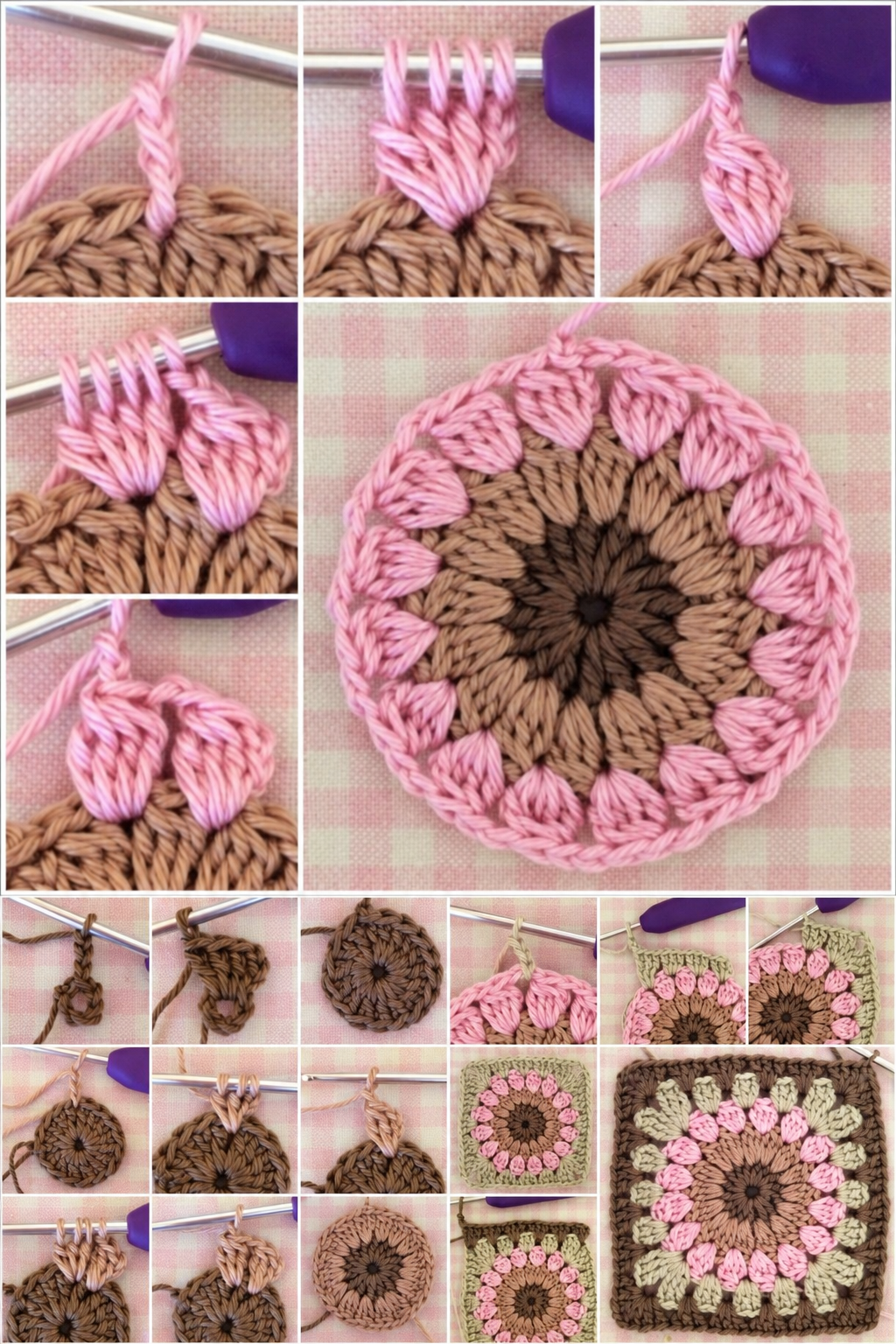
The decorative sections of this Crochet Square Pattern use grouped stitches that create the petal appearance. A cluster stitch is made by beginning several tall stitches in the same stitch or space but leaving the final loop of each stitch on the hook. Yarn over and pull through all remaining loops together to close the cluster. When three unfinished double crochets are combined, it may be written as 3-DC-cluster. When four unfinished stitches are grouped, it may be written as 4-DC-cluster.
For a 3-DC-cluster, use this key: [YO, insert hook in indicated stitch or space, YO, pull up a loop, YO, pull through 2 loops] ×3, YO, pull through all remaining loops. The brackets show the complete repeated action needed to form one cluster. Keep the loops slightly loose so the hook can pass through them easily when closing the stitch.
For a fuller petal, use a 4-TR-cluster or elongated cluster. The key can be written as [YO twice, insert hook, YO and pull up loop, YO through 2, YO through 2] ×4, YO and pull through all remaining loops. These taller stitches produce the long teardrop-shaped petals visible in the motif. If you prefer a shorter texture, four double-crochet stitches can be substituted, although the final appearance will be less elongated.
Before beginning, make a small tension sample if your square must match other squares in a blanket. Crochet motifs can vary noticeably in size when made by different people or hooks. A practical target for this project is approximately 6–7 inches (15–18 cm) after the square border is completed, depending on yarn weight and the number of border rounds. The exact measurement is less important than keeping every crochet square in the same project consistent.
Creating the Circular Center and Textured Flower Rounds
Begin the Crochet Square Pattern with a magic ring. If you do not enjoy using a magic ring, ch 4 and sl st into the first ch to form a small ring. Round 1 can be worked with 12 double crochets. Use ch 3, 11 DC into ring, sl st to top of beginning ch-3. Tighten the center firmly before weaving in the yarn tail.
For Round 2, change to a slightly lighter brown if you want the layered color effect shown in the example. Work elongated groups around the circle. A simple sequence is ch 2, 2-DC-cluster in same stitch, ch 1, [3-DC-cluster in next stitch, ch 1] around, sl st to first cluster. You should have 12 evenly distributed textured sections. Keep counting because these groups establish the spacing for the following decorative rounds.
Round 3 creates a second flower-like layer. Join the next brown shade into any chain-1 space. Work ch 2, 3-DC-cluster in same space, ch 1, then repeat [4-DC-cluster in next ch-1 space, ch 1] around. Join with a slip stitch. The motif should now resemble a small textured flower with elongated petals radiating from the center.
The pink round gives the Crochet Square Pattern its most distinctive appearance. Join pink yarn into one of the spaces between the brown petals. Work ch 2, 3-TR-cluster in same space, ch 1. Continue with [4-TR-cluster in next space, ch 1] around and join. Adjust the number of yarn overs if necessary to make the petals tall enough to sit clearly above the brown background.
When making the tall pink petal, remember not to complete each treble crochet separately. Use [YO twice, insert hook into space, YO and pull up loop, YO through 2, YO through 2], leaving the final loop on your hook. Repeat the action until the desired number of unfinished tall stitches has been created. Finally, YO and pull through all loops. This closing movement gathers the stitches into the characteristic pointed petal.
After completing the pink round, place the motif on a flat surface. It should remain approximately circular without severe cupping. Slight curling is normal because the cluster stitches are dense. However, if the circle forms a deep bowl, increase your chain spaces or move up one hook size. If the work becomes excessively wavy, reduce the chain spaces or use a slightly smaller hook.
Turning the Round Motif Into a Crochet Square
The next stage transforms the decorative circle into a true Crochet Square Pattern. This is accomplished by establishing four corners at equal distances around the motif. Before crocheting, divide the total number of spaces into four equal sections. Place a removable marker at four locations if necessary. Correct positioning here prevents the finished square from becoming uneven or diamond-shaped.
Join your light green, cream, beige, or preferred contrast color into one of the marked corner spaces. A useful corner sequence is [3 DC, ch 2, 3 DC] in the same corner space. This combination produces the extra width necessary to turn the work outward. Continue along the first side with regular stitch groups such as 3 DC in each available space, separating groups with ch 1 when needed.
At the second marked corner, repeat [3 DC, ch 2, 3 DC] in corner space. Continue the same side pattern and repeat this construction at all four corners. Finish the round with a slip stitch. You should now see four obvious points developing. The motif may still appear rounded between them, which is completely normal at this stage.
For a more decorative appearance similar to the photograph, the first squaring round can use cluster stitches rather than plain double crochet. Try 3-DC-cluster, ch 1 along the sides, while using [3-DC-cluster, ch 2, 3-DC-cluster] in every corner. This preserves the raised floral character of the center while gradually creating straight edges.
The following round strengthens the square shape. Join the darker border color into a corner. Work ch 3, 2 DC, ch 2, 3 DC into the corner space. Across each side, crochet 3 DC in each ch-1 space or work regular double crochets evenly across the edge. In every corner, repeat [3 DC, ch 2, 3 DC]. This reliable corner formula can also be used to enlarge the motif.
Check your work after completing each side. The four sides should have matching stitch counts, and every corner should contain the same increase structure. If one side contains an extra group, the square may twist after blocking. Accurate counting is particularly important when several Crochet Square Pattern motifs will later be joined into a blanket because matching stitch counts simplify assembly considerably.
Finishing, Blocking, Joining, and Customizing the Crochet Square Pattern
Once your basic Crochet Square Pattern has reached the desired size, finish with one simple border round. A single crochet border is excellent for keeping the edges neat. Begin in a corner and work SC in each stitch across, placing [SC, ch 2, SC] into each corner space. Join with a slip stitch and fasten off.
For a more traditional granny-style border, continue working groups of double crochet instead. Use 3 DC in each space and [3 DC, ch 2, 3 DC] in each corner. Every additional border round increases the finished square while preserving the original construction. This makes it easy to transform a small motif into a larger cushion panel or blanket block.
Weave in every yarn end securely with a yarn needle. Because this design changes colors several times, there may be multiple tails. Thread each tail under several stitches on the wrong side, change direction, and weave through another short section. Avoid pulling too tightly because this can distort the round floral center.
Blocking significantly improves the finished appearance. Lightly dampen the square or use the blocking method recommended for your yarn fiber. Arrange it on a flat blocking surface and gently stretch the four corners until the sides are straight. Pin each corner and several points along the sides. Allow the crochet square to dry completely before removing the pins.
If you plan to join multiple squares, there are several simple options. Squares can be whip stitched together using a yarn needle, slip stitched together with a crochet hook, or joined with single crochet for a visible raised seam. For a flatter blanket, mattress-style seaming or slip-stitch joining through the back loops creates a neat result.
Color customization can completely change this Crochet Square Pattern. Brown, pink, and sage create a soft botanical look, while red, white, and green can make it suitable for Christmas projects. Orange, cream, brown, and gold create an autumn palette. Bright scraps can transform the same construction into a cheerful patchwork blanket. Because the shape remains consistent, you can experiment freely while maintaining a coordinated finished project.
Frequently Asked Questions About the Crochet Square Pattern
What skill level is recommended for this Crochet Square Pattern?
This project is best for an adventurous beginner or intermediate crocheter. Basic double crochet is simple, but the pattern also introduces cluster stitches, color changes, working in the round, and corner shaping. Beginners can practice each special stitch separately before starting the complete square.
What yarn is best for crochet squares?
Worsted-weight cotton or acrylic yarn is an excellent option because it offers good stitch definition without making the motif too stiff. Cotton is especially attractive for bags, table mats, and decorative projects, while acrylic is soft and practical for blankets and cushions.
How large should a finished crochet square be?
There is no single required measurement. Using medium yarn and a 4.5–5 mm hook, this type of motif may finish around 6–7 inches (15–18 cm) depending on your tension and number of border rounds. The important rule is to make every square intended for the same project approximately the same size.
Why is my crochet square curling?
Curling usually indicates that the stitch count, tension, or hook size needs adjustment. Dense cluster stitches can initially cause mild curling, which often improves after additional rounds and blocking. Severe cupping may mean the motif needs more stitches or slightly larger chain spaces.
Why is my Crochet Square Pattern wavy?
A wavy edge usually means there are too many stitches or increases in the round. Check the pattern carefully, verify the number of clusters, and make sure extra stitches have not accidentally been worked into joining stitches.
Can I make the square larger?
Yes. Continue adding border rounds while maintaining the same corner rule. A dependable formula is [3 DC, ch 2, 3 DC] in each corner, with evenly spaced stitch groups along every side. Each additional round naturally increases the dimensions.
Can I use only one color?
Absolutely. A solid-color Crochet Square Pattern emphasizes texture rather than color contrast. Cream, white, charcoal, dusty rose, sage, or deep blue can produce an elegant monochromatic motif.
How do I keep the pink petals uniform?
Maintain the same number of unfinished tall stitches in every cluster and keep your tension consistent. When closing each cluster, avoid pulling the final loop excessively tight. Counting every cluster also ensures that all petals remain evenly positioned.
Can these squares be used for a blanket?
Yes. This motif is especially suitable for blankets because the finished square edges can be joined easily. Make several identical squares or alternate the colors while keeping the final round consistent for a unified appearance.
Do I need to block every square before joining them?
Blocking is strongly recommended when making a multi-square project. It gives the motifs consistent dimensions, straightens the sides, improves the corners, and makes joining considerably easier.
What does the crochet cluster key mean?
A cluster key explains how several partially completed stitches are combined into one decorative stitch. For example, [YO, insert hook, pull up loop, YO, pull through 2] ×3, YO and pull through all loops creates a compact cluster by joining three unfinished double crochets at the top.
Can leftover yarn be used for this pattern?
Yes. Because each color round uses a relatively small amount of yarn, this Crochet Square Pattern is a practical scrap-yarn project. Just try to use yarns of similar thickness so the motif stays balanced.
Conclusion
The Crochet Square Pattern combines several enjoyable crochet techniques in one attractive project: working in the round, making textured crochet clusters, creating elongated flower-like petals, changing colors, establishing four corners, and finishing the motif with structured border rounds. Starting from the small circular center, each new round adds texture and dimension until the original flower-like motif gradually becomes a balanced square.
The main idea to remember is to work carefully and count consistently. Begin with the center ring, build the brown textured sections, add the decorative pink cluster petals, divide the circular motif into four equal sections, and use strategic corner increases to create the square. Finish with one or more border rounds, weave in the ends, and block the finished piece for clean, professional-looking edges.
Once you understand the construction, this pattern offers many possibilities. You can make one square for a small decorative project or crochet dozens for a larger blanket. You can use soft botanical shades like the example, create a colorful scrap-yarn version, or choose seasonal colors. The same fundamental Crochet Square Pattern can look completely different simply by changing yarn colors, fibers, hook size, and border width.