
One of the most attractive features of this crochet flower pattern is its versatility. Although red and green are traditional Christmas colors, the flowers can also be made in white, gold, burgundy, or soft pastel shades. Their dimensional petals give them a realistic appearance, while the raised edges and decorative stamens add texture and movement. Whether you want to decorate a Christmas wreath, embellish a handmade bag, or create beautiful holiday table decorations, these flowers offer countless possibilities.
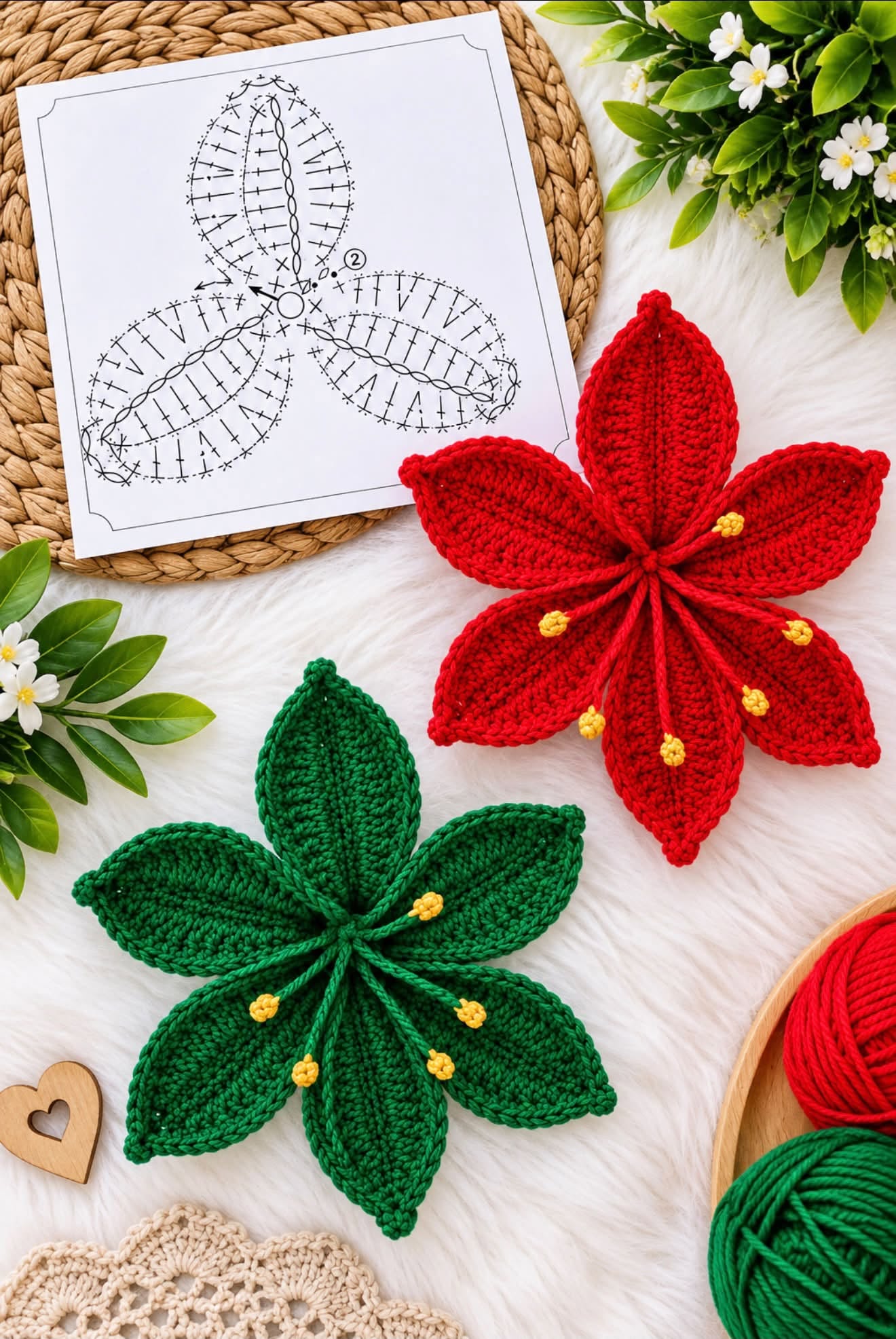
Creating a handmade crochet Christmas flower is also a wonderful opportunity to practice essential crochet techniques. The project involves shaping individual petals, working increases and decreases, creating decorative borders, and assembling the finished flower. Beginners with basic crochet experience can follow the instructions, while more experienced crocheters can experiment with different yarn weights and petal arrangements. The instructions below provide an original approach inspired by the flower in the photograph, rather than an exact transcription of the illustrated stitch chart.
Materials and Supplies for the Crochet Christmas Flower Pattern
Before starting your Crochet Christmas Flower Pattern, gather the necessary materials. Choosing the right yarn and crochet hook is important because the finished flower should be flexible enough to shape while maintaining a firm, structured appearance.
For a decorative flower similar to the design shown, medium-weight cotton yarn is an excellent choice. Cotton provides clear stitch definition and helps individual petals maintain their shape. Acrylic yarn is another option, particularly when making lightweight ornaments or larger decorations.
Recommended materials:
-
Medium-weight cotton yarn (weight 4) in Christmas red or emerald green.
-
Small amount of yellow yarn for decorative stamens.
-
Matching yarn for joining the petals.
-
3.5 mm or 4.0 mm crochet hook (US E/4 or G/6).
-
Yarn needle for sewing and finishing.
-
Sharp scissors.
-
Stitch markers.
-
Optional fabric stiffener for firmer petals.
-
Optional floral wire for decorative stems, if the flower will be used away from children.
A single flower generally requires approximately 35–55 yards (32–50 meters) of the main yarn color, depending on the size, stitch tension, and number of petals. The yellow details require only a few yards of yarn.
The flowers in the photograph feature pointed, oval-shaped petals arranged around a central point. Each petal is slightly raised and finished with a decorative edge, creating a layered appearance.
For a flower measuring approximately 7–9 inches (18–23 cm) across, use medium-weight yarn and a 4.0 mm hook. Smaller flowers can be created using lightweight cotton yarn and a 2.5 mm or 3.0 mm hook. These dimensions are estimates and will vary with your tension and shaping.
Crochet abbreviations (US terminology):
| Abbreviation | Meaning |
|---|---|
| ch | Chain |
| sl st | Slip stitch |
| sc | Single crochet |
| hdc | Half double crochet |
| dc | Double crochet |
| tr | Treble crochet |
| st(s) | Stitch(es) |
| inc | Increase |
| dec | Decrease |
| FO | Fasten off |
The design uses familiar crochet stitches, making it a satisfying project for crocheters who enjoy decorative motifs. Keeping stitches consistent will help all the petals look balanced when assembled.
How to Crochet the Christmas Flower Petals Step by Step
The central feature of this Crochet Christmas Flower Pattern is its arrangement of pointed petals. The red flower shown has six petals, while the green version has five. Both variations can be created with the same basic petal construction method.
For a beginner-friendly version, each petal can be worked separately using rows of single crochet stitches. This approach creates a firm fabric that is easy to shape and assemble into a three-dimensional flower.
Step 1: Create the foundation of the petal
Start with the main yarn color and make a slip knot. Chain 3.
Row 1: Work 2 sc in the second chain from the hook and 1 sc in the last chain. Chain 1 and turn. You should have 3 stitches.
Row 2: Work 2 sc in the first stitch, 1 sc in the next stitch, and 2 sc in the last stitch. Chain 1 and turn. You should have 5 stitches.
These first rows create the narrow base of the petal, allowing it to fit neatly into the center of the flower.
Step 2: Increase to create the oval shape
Row 3: Work 2 sc in the first stitch, sc across until the final stitch, and work 2 sc in the last stitch. Chain 1 and turn. You should have 7 stitches.
Repeat this increase method in Rows 4–7, adding two stitches per row.
At the end of Row 7, you should have 15 stitches. The petal will gradually become wider, forming the rounded middle section.
The number of increase rows may be adjusted for larger or smaller flowers. Keeping the increases symmetrical produces a balanced petal.
Step 3: Build the length of the petal
Rows 8–12: Work 1 sc in every stitch across. Chain 1 and turn after each row except where indicated by the next instruction.
These straight rows create the widest portion of the petal. If you prefer longer petals, add two or three extra rows before beginning the decreases.
For a slightly curved appearance, maintain firm tension near the outer edges while allowing the center stitches to remain relaxed.
Step 4: Shape the pointed tip
Row 13: Work sc2tog, sc across until two stitches remain, and sc2tog over the final two stitches. Chain 1 and turn. You should have 13 stitches.
Repeat this decrease method on each following row until only 3 stitches remain.
Final row: Work sc3tog to form a single pointed tip. Fasten off, leaving a yarn tail to weave in.
Your petal should now have a narrow base, a wider middle section, and a pointed outer tip.
Step 5: Crochet the decorative border
Join the yarn near the base of the petal. Work single crochet stitches evenly around the outside edge.
Along the longer sides, distribute stitches carefully to prevent the border from gathering or becoming wavy.
At the pointed tip, work 3 sc into the tip area to maintain a defined point. Continue around the opposite side and join with a slip stitch.
For a more pronounced decorative edge, work a second round of reverse single crochet, also known as the crab stitch. This produces a raised cord-like finish similar to the textured edges visible in the photograph.
Make five or six matching petals, depending on your preferred finished flower arrangement.
Assembling the Crochet Flower and Adding Decorative Details
Once all the petals are complete, the next stage is transforming the individual pieces into a beautiful 3D crochet Christmas flower. Proper positioning is essential for achieving a balanced and realistic appearance.
Lay the petals on a flat surface with their narrow bases facing the center. Arrange them in a circular formation, allowing the petals to overlap slightly. The pointed tips should face outward, creating a star-shaped floral silhouette.
Step 1: Join the petals
Thread a yarn needle with a length of matching yarn.
Bring the narrow bases of the petals together at the center and sew through each base several times. Keep the stitches firm enough to hold the arrangement securely.
Avoid pulling the yarn too tightly, as this may cause the petals to bunch unevenly.
For extra reinforcement, crochet a small central circle using a magic ring and 6 sc. Increase to 12 sc in the next round, then fasten off.
Sew this circle behind the joined petals to provide additional stability and help maintain the flower’s shape.
Step 2: Create the decorative stamens
The yellow details give the crochet Christmas flower its beautiful finishing touch.
With green or red yarn, chain 10–14 to create a slender strand extending outward from the center.
At the end of the strand, attach yellow yarn and work a small cluster of stitches. A simple decorative option is to work 4 sc into a magic ring, pull it tightly closed, and secure it to the tip of the strand.
Alternatively, make a tiny yellow bobble using several partially completed double crochet stitches closed together.
Create five or six stamens in slightly different lengths to add natural movement and variety.
Step 3: Attach the stamens
Position the completed stamens at the center of the flower.
Sew the bottom of each strand securely to the central joining area. Spread the strands across the petals so that the yellow tips remain visible.
The photograph shows decorative strands extending outward from the center, giving the flower a distinctive dimensional appearance.
Step 4: Shape the finished flower
Gently adjust the petals with your fingers to create a balanced arrangement.
If your yarn allows it, lightly dampen the petals and pin them into the desired shape on a blocking mat. Allow them to dry completely before removing the pins.
For decorations that need to hold a specific shape, apply a small amount of fabric stiffener according to the manufacturer’s instructions.
Keep the flower away from direct heat while drying, especially when using acrylic yarn.
Step 5: Finish the back
Weave in all remaining yarn ends carefully.
If you want to turn your flower into a hanging ornament, sew a small yarn loop to the back.
For wreaths, bags, or decorative cushions, leave the back flat so the flower can be attached securely.
You now have a beautiful handmade flower with raised petals, elegant edging, and delicate yellow accents.
Creative Ways to Use Crochet Christmas Flowers in Holiday Decorations
One of the greatest advantages of this crochet flower tutorial is the variety of ways the finished flowers can be used. Their vibrant colors and sculptural petals make them suitable for everything from traditional Christmas decorations to everyday handmade accessories.
A popular option is to attach several flowers to a Christmas wreath. Combine red flowers with green crocheted leaves, pinecones, and ribbon to create a festive arrangement. A wreath decorated with handmade crochet elements has a cozy and personalized appearance.
These flowers also work beautifully as Christmas tree ornaments. Use a smaller crochet hook and lightweight yarn to create compact versions that can hang comfortably from tree branches.
For a festive dining table, arrange the flowers around candles, napkin rings, or decorative centerpieces. Keep yarn decorations a safe distance from flames and other heat sources.
Another creative idea is to attach the flowers to handmade gift bags or reusable fabric gift wrapping. A crochet flower adds a thoughtful touch and can be reused by the recipient as a decoration.
You can also create larger flowers using bulky yarn and a bigger crochet hook. These oversized versions are excellent for wall hangings, decorative garlands, or seasonal photo displays.
Popular Christmas color combinations include classic red and green, ivory and gold, burgundy and forest green, and winter white with silver accents.
For a traditional poinsettia-inspired appearance, use deep red petals with yellow centers and add several dark green crochet leaves behind the flower.
If you prefer a modern aesthetic, combine soft cream, sage green, and champagne-colored yarn. These shades create a sophisticated decoration that works well with neutral holiday interiors.
The petal design can also be adapted for spring or summer decorations. Pink, lavender, peach, and yellow flowers are wonderful additions to seasonal wreaths, handmade accessories, and floral crochet arrangements.
Crochet flowers are also thoughtful handmade gifts. A collection of colorful flowers can be arranged into a small bouquet, attached to a decorative basket, or included with other handmade craft items.
For crocheters who enjoy selling their handmade creations, these flowers can become charming seasonal accessories. Experimenting with different sizes and color combinations allows each design to feel distinctive.
The most important finishing detail is consistency. Petals that have been crocheted with similar tension and carefully shaped will create a more polished and professional-looking flower.
Frequently Asked Questions About the Crochet Christmas Flower Pattern
Is this crochet Christmas flower suitable for beginners?
Yes. The beginner-friendly version described in this tutorial uses basic stitches, simple increases and decreases, and straightforward assembly techniques. Some previous crochet experience is helpful.
How many petals should a crochet Christmas flower have?
You can make five or six petals. The green flower in the inspiration image has five petals, while the red flower has six. Both arrangements create attractive floral designs.
What is the best yarn for crochet flowers?
Cotton yarn is an excellent choice because it provides clear stitch definition and helps the petals maintain their shape. Acrylic yarn can also be used for soft, lightweight decorations.
How can I make the petals stiffer?
Blocking and fabric stiffener can help the petals maintain their shape. Use only products suitable for your yarn fiber and allow the flowers to dry completely.
Can I use this pattern to make Christmas tree ornaments?
Absolutely. Make smaller flowers using finer yarn and a smaller crochet hook. Add a hanging loop to the back so the ornaments can be placed on Christmas tree branches.
Can the petals be made in different colors?
Yes. Each petal can be crocheted in a different color, or the entire flower can be made in one shade. You can also create contrasting decorative borders.
How long does it take to crochet one flower?
Depending on your experience and the flower’s size, a complete flower may take approximately two to four hours. Additional time may be needed for blocking and finishing.
Can I wash handmade crochet flowers?
Many cotton and acrylic yarns are washable, but always follow the yarn manufacturer’s care instructions. Flowers containing wire, stiffener, or glued embellishments may require gentle spot cleaning instead.
Conclusion
The Crochet Christmas Flower Pattern is a delightful way to combine traditional crochet techniques with festive creativity. Its beautifully shaped petals, textured borders, and cheerful yellow details make it an attractive decoration for Christmas and beyond.
Whether you choose vibrant red, rich emerald green, or another favorite color combination, each flower can become a unique handmade creation. The individual petals offer opportunities to practice crochet shaping, while the finishing details allow you to personalize the design.
With a few basic materials, patience, and attention to detail, you can create beautiful dimensional flowers for wreaths, ornaments, gift decorations, and seasonal home accessories. This handmade crochet flower project is a wonderful way to celebrate the beauty of yarn crafts while adding a personal touch to your holiday decorating.