
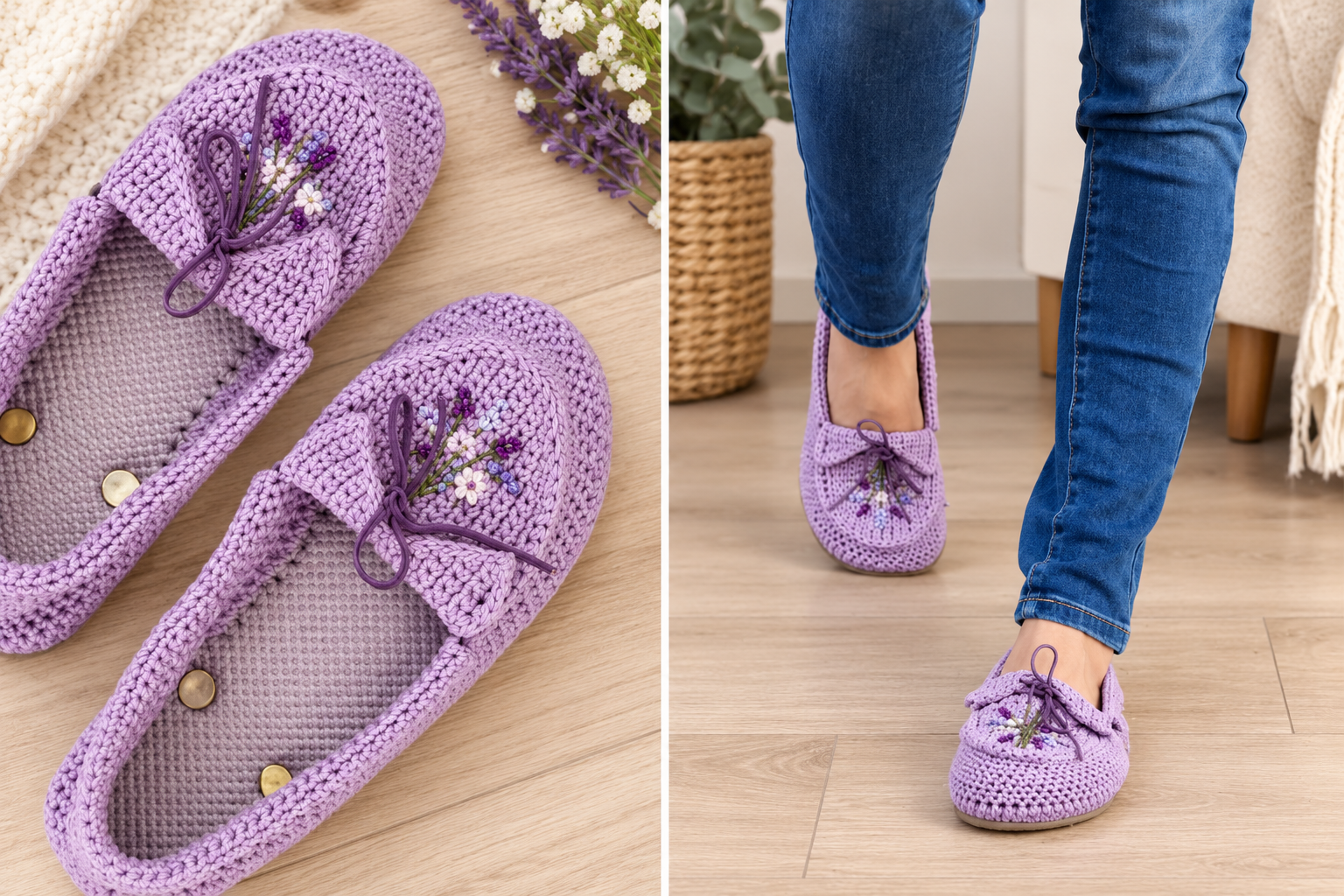
The Lavender Crochet Slippers Pattern is a beautiful handmade footwear project that combines comfort, elegance, and creativity. Featuring delicate lavender-colored crochet stitches, charming floral embroidery, and decorative bows, these cozy slippers offer a wonderful way to bring handmade luxury into everyday life. Whether you enjoy making practical accessories or creating thoughtful gifts, this project is an excellent addition to your crochet collection.
One of the most attractive features of these crochet moccasin slippers is their sophisticated appearance. The textured crochet fabric creates a soft, welcoming look, while the small embroidered flowers add a romantic, vintage-inspired touch. The purple ribbon bows complete the design, transforming a simple pair of slippers into something special. Their classic shape makes them suitable for relaxing at home, enjoying a peaceful morning, or adding a little elegance to a comfortable outfit.
Making your own handmade crochet slippers also allows you to personalize the fit, colors, and decorative details. You can choose soft cotton-blend yarn for breathable footwear, select warmer acrylic or wool blends for winter, or experiment with beautiful pastel shades. In this tutorial, you will learn how to create slippers inspired by the pictured design, including recommended materials, measurements, crochet stitches, assembly instructions, floral decorations, and finishing techniques.
1. Materials and Measurements for Lavender Crochet Slippers
Before starting this Lavender Crochet Slippers Pattern, gather the materials needed to create a durable, comfortable pair. Choosing appropriate yarn and a suitable hook is especially important because slippers should maintain their shape while remaining flexible enough for walking.
Recommended materials:
- Approximately 200–300 yards (183–274 meters) of medium-weight yarn in lavender.
- A 4.0 mm (G/6) crochet hook, adjusted to your gauge.
- Small amounts of white, violet, lilac, and green embroidery thread.
- Matching lavender yarn or soft cord for decorative bows.
- Yarn needle with a large eye.
- Stitch markers.
- Scissors and measuring tape.
- Two washable slipper insoles, if desired.
- Flexible non-slip sole material or suitable traction treatment.
- Optional soft fabric lining for additional comfort.
For this tutorial, the sample size is approximately US women’s size 8, with a finished sole length of about 9.75 inches (24.8 cm). Because crochet tension varies, the measurements should be checked throughout the project rather than relying on stitch counts alone.
| US Women’s Size | Approximate Foot Length |
|---|---|
| 6 | 9 in (22.9 cm) |
| 7 | 9.25 in (23.5 cm) |
| 8 | 9.5 in (24.1 cm) |
| 9 | 10 in (25.4 cm) |
| 10 | 10.25 in (26 cm) |
These measurements are general references. Measure the intended wearer’s foot and customize the slipper length, width, and instep opening for the most comfortable fit.
A useful starting gauge is approximately 16 single crochet stitches and 18 rows per 4 inches (10 cm) when working in a firm fabric. Your gauge may differ depending on the yarn, hook, and stitch technique. Making a small test swatch helps determine whether adjustments are necessary.
The example below uses standard U.S. crochet terminology and creates separate shaped soles, sides, and decorative front panels. The method is an original interpretation of the photographed slippers rather than an exact reconstruction of an unpublished pattern.
2. Step-by-Step Crochet Instructions for the Slipper Base
The foundation of this crochet slipper pattern is an elongated oval sole. Starting with a flat base makes it easier to control the shape, accommodate different foot sizes, and attach the upper section neatly.
U.S. crochet stitch abbreviations:
- ch: Chain
- sc: Single crochet
- hdc: Half double crochet
- dc: Double crochet
- sl st: Slip stitch
- st/sts: Stitch/stitches
- inc: Work two stitches into the same stitch
- dec: Single crochet two stitches together
- BLO: Back loop only
Step 1 – Create the foundation chain
Begin with a slip knot and chain 26 using lavender yarn. This is a starting count for the sample, not a universal size. The exact foundation length should be adapted to your gauge and desired sole measurement.
Work two single crochet stitches into the second chain from the hook. Continue working one single crochet into each chain until reaching the last chain. Make three single crochet stitches into the final chain to turn around the end.
Continue along the opposite side of the foundation chain. Work one single crochet into each available chain space, shaping the opposite edge of the oval. Add a stitch at the rounded end as needed to complete a smooth first round.
Step 2 – Expand the oval sole
Continue crocheting in rounds, placing increases around the toe and heel. Keep the long sides relatively straight so that the sole develops an elongated, foot-shaped appearance rather than becoming circular.
Alternate single crochet and half double crochet where appropriate to build a firm but comfortable fabric. Distribute increases evenly on the curves to prevent puckering or excessive waviness.
Lay the piece flat after each round. If the edges begin curling upward, additional increases may be needed. If the sole becomes wavy, reduce the frequency of increases.
Step 3 – Complete the sole
Continue until the sole reaches the required length and width. For the sample US size 8, aim for approximately 9.75 inches (24.8 cm) long and 3.5–3.75 inches (8.9–9.5 cm) across the widest section.
Make a second matching sole. If you want a thicker slipper base, crochet two additional oval pieces and join each pair with single crochet stitches around the perimeter.
A double-layer base provides extra cushioning and helps the slippers keep their shape. However, thicker soles should still be flexible enough to bend naturally with the foot.
Step 4 – Build the side walls
Join lavender yarn to the back loop of a stitch along the completed sole. Work one single crochet into each stitch around the entire perimeter, without increasing.
Continue for approximately three to five rounds, depending on the desired side height. Working the first round in the back loops creates a defined transition between the flat sole and upright sides.
Try the slipper base against the wearer’s foot. The sides should gently surround the foot without squeezing the heel or toes.
Step 5 – Shape the heel and opening
Mark the center heel and center toe. Work additional rows across the back portion to raise the heel, gradually tapering the sides if necessary.
Leave an opening large enough for the foot to slide into comfortably. For a moccasin-style appearance, the opening should extend toward the front while still allowing the finished upper to hold the slipper in place.
Keep both slippers symmetrical by counting rows carefully and measuring corresponding sections before fastening off.
Step 6 – Prepare the upper section
Create a rounded front panel using rows of half double crochet, gradually increasing or decreasing the width to match the front opening of the slipper.
The panel should cover the toes and extend slightly over the instep. A softly curved upper resembles the traditional moccasin shape seen in the reference image.
Position the panel on the slipper and temporarily secure it with stitch markers. Check the fit before joining it permanently. The panel should remain comfortably loose over the toes while providing sufficient coverage.
3. Creating the Floral Embroidery and Decorative Bows
The most distinctive feature of these lavender floral crochet slippers is the delicate flower arrangement decorating the front. Small embroidered blossoms in white, purple, and soft blue create a vintage garden appearance that complements the lavender yarn beautifully.
Before embroidering, attach the front panel around its toe and side edges using a yarn needle and matching yarn. Leave the upper opening free, and ensure that the joining seam feels smooth against the foot. A neat whipstitch or mattress stitch is appropriate for this step.
To create the floral details, thread a needle with white or pale lavender embroidery floss. Work small lazy daisy stitches to form five-petal flowers. Add a tiny yellow or purple French knot in the center of each flower for additional texture.
Create slender stems using green embroidery thread and simple straight stitches. Arrange the stems in slightly different directions, allowing the design to resemble a small bouquet. Add several tiny purple buds to create dimension and visual interest.
For the larger purple blossoms, use a combination of French knots and short detached chain stitches. Keep the embroidery concentrated near the center of the upper panel so that it does not interfere with the slipper’s fit or side seams.
To make the decorative bow, cut approximately 12–16 inches (30–40 cm) of soft lavender cord or create a crocheted chain of a similar length. Position it above the embroidered bouquet and form a neat bow. Secure the knot with a few hidden stitches if necessary, and trim the ends evenly.
The decorations can be customized for different styles. Dusty rose and cream flowers provide a romantic vintage appearance, while white blossoms with sage-green stems create a softer botanical finish. For holiday gifts, consider burgundy flowers with tiny golden accents.
A useful decorative tip is to embroider both front panels before attaching them if you prefer working on a flat surface. This makes it easier to maintain consistent flower placement and prevent the stitching from accidentally catching the opposite layers.
4. Finishing, Customizing, and Caring for Crochet Slippers
Finishing is an essential part of making comfortable handmade crochet slippers. Small details such as secure seams, smooth edging, and proper sole construction can make a significant difference in how the completed footwear feels during everyday use.
After attaching the uppers, work one round of single crochet around each slipper opening. This creates a clean border and helps stabilize the edge. For a slightly more decorative appearance, finish with a round of reverse single crochet, sometimes called crab stitch.
Weave in all loose yarn ends securely using a yarn needle. Avoid leaving thick knots inside the slippers, particularly near the toes or heel, where they might cause discomfort. Inspect every joining seam to ensure it is strong and flexible.
The soles deserve special attention because ordinary crocheted fabric can be slippery on hardwood, tile, or polished flooring. Attach a suitable flexible non-slip outsole or professionally designed traction material according to its instructions. Do not assume that decorative buttons or untreated crochet stitches provide reliable grip.
For additional softness, insert a thin washable fabric or foam insole. If the slippers will be used regularly, choose an insole that can be removed for cleaning. Avoid bulky layers that make the toe section tight or change the intended fit.
These crochet moccasin slippers also make thoughtful handmade gifts for birthdays, Mother’s Day, Christmas, or special occasions. You can personalize them with a recipient’s favorite colors, embroidered initials, tiny flowers, or matching accessories such as a crocheted headband.
To maintain the slippers, gently hand-wash them in cool water with mild detergent, provided the yarn and other materials are washable. Avoid excessive twisting or wringing. Reshape them carefully and allow them to air-dry completely on a flat surface.
Store the slippers in a clean, dry location away from direct sunlight. Proper care helps preserve the yarn’s softness, the flowers’ delicate appearance, and the overall structure of the handmade footwear.
Frequently Asked Questions About Lavender Crochet Slippers
Are these crochet slippers suitable for beginners?
Yes. The basic construction uses familiar stitches such as single crochet, half double crochet, and slip stitch. However, shaping the upper and achieving a comfortable fit may be easier for crocheters with some previous experience.
What yarn is best for crochet slippers?
Medium-weight cotton blends, wool blends, and soft acrylic yarns are popular options. Look for yarn that offers durability, moderate elasticity, and pleasant texture. Avoid overly delicate fibers that wear out quickly.
Can I make these slippers in different sizes?
Absolutely. Measure the foot, adjust the foundation chain, and continue increasing the sole until it reaches the desired dimensions. The side walls and front panels must also be adjusted to match.
How do I prevent crochet slippers from slipping on the floor?
Use a properly attached non-slip outsole or a traction product designed specifically for handmade slippers. Always test the finished slippers on the intended flooring and avoid using them on slippery surfaces if adequate grip cannot be achieved.
Can I replace the embroidered flowers with crocheted flowers?
Yes. Small crocheted appliqué flowers can be stitched onto the upper panels instead of embroidery. Choose lightweight flowers with flat backs so that the decorations do not make the slippers unnecessarily bulky.
How long does it take to make a pair of crochet slippers?
The project may take approximately five to ten hours, depending on crochet experience, slipper size, and the complexity of the decorative embroidery. Beginners may need additional time to adjust the fit.
Can these slippers be washed in a washing machine?
That depends on the yarn, added insoles, decorations, and sole materials. Gentle hand-washing is generally a safer choice for preserving the detailed floral embellishments and overall shape.
Are crochet slippers a good handmade gift?
Yes. Their combination of comfort, practical use, and personalization makes them a lovely gift. A handmade pair with beautiful floral details can feel especially meaningful because of the care and creativity involved.
Conclusion
The Lavender Crochet Slippers Pattern brings together the beauty of traditional crochet, the charm of floral embroidery, and the comfort of handmade footwear. With their soft lavender color, textured stitches, delicate flowers, and decorative bows, these slippers offer a timeless design that feels both elegant and welcoming.
Creating a pair allows you to explore different crochet techniques while producing something useful and attractive. From shaping the oval soles to adding the final embroidered flowers, each stage provides an opportunity to develop your skills and enjoy the creative process.
Whether you make them for yourself, prepare them as a thoughtful gift, or customize them in your favorite colors, these handmade floral crochet slippers are a wonderful example of how simple yarn can become a beautiful everyday accessory. With careful measurements, secure construction, and appropriate non-slip soles, you can create cozy slippers that are as practical as they are charming.