
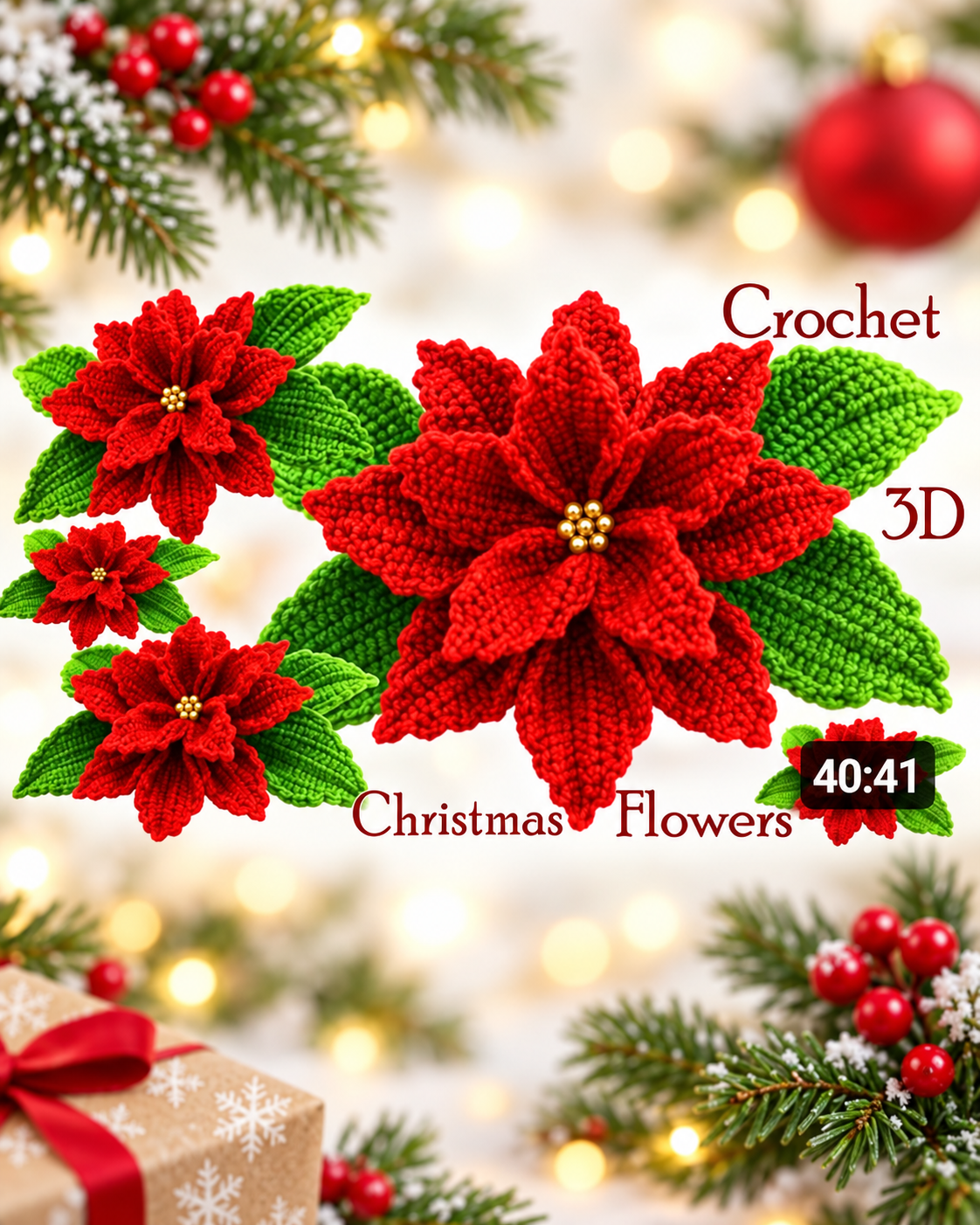
3D crochet Christmas flowers Pattern is a beautiful holiday project for anyone who enjoys turning simple crochet stitches into dimensional decorations with a polished, festive appearance. Inspired by the classic poinsettia shape shown in the reference image, this design combines layered red petals, textured green leaves, and a decorative center to create a flower that looks full from every angle. The three-dimensional construction is what makes this project especially attractive for Christmas decorating because the petals do not lie completely flat. Instead, they overlap naturally and can be shaped upward to create depth. The finished flowers can be used on wreaths, table arrangements, gift packages, garlands, baskets, stockings, and other handmade decorations. This tutorial uses standard U.S. crochet terminology and explains the construction in manageable stages so that crocheters can understand how each individual component contributes to the final flower.
One advantage of the 3D crochet Christmas flowers Pattern is that the finished size can easily be adjusted by changing the yarn weight, crochet hook, or number of rounds used in each petal and leaf. A medium-weight yarn creates a substantial decorative flower, while lighter yarn produces smaller ornaments suitable for Christmas trees and gift wrapping. For the classic holiday appearance, use a strong red yarn for the petals, bright or deep green for the leaves, and gold beads or small crocheted bobbles for the center. Cotton yarn is excellent when you want clearly defined stitches and firm petals, while acrylic yarn may produce a softer flower with more flexibility. The most important detail is maintaining fairly firm tension so the petals hold their shape instead of becoming too loose. Because this is a decorative project rather than a fitted garment, exact gauge is not essential, making it a relaxing pattern for many skill levels.
The main techniques in this 3D crochet Christmas flowers Pattern include chain stitch, slip stitch, single crochet, half double crochet, double crochet, increases, decreases, working around foundation chains, and assembling separate crochet pieces. Crocheters who already know these basic techniques should find the project straightforward, while adventurous beginners can use it to practice shaping. The flower is built from several pointed petals arranged in layers, with larger petals on the outside and smaller petals closer to the center. Crochet leaves are added underneath the red petals to reproduce the natural star-like silhouette associated with Christmas poinsettias. A small cluster in the center completes the design and visually connects all the petals. Careful finishing and shaping are just as important as the crochet itself because arranging the petals at slightly different angles produces the realistic three-dimensional effect.
Materials, Crochet Terms, and Preparation
For one medium-size 3D crochet Christmas flower, prepare approximately 45–65 yards of red yarn and 25–40 yards of green yarn. Small amounts of gold or yellow yarn can be used for a crocheted center, or you can substitute decorative craft beads that are firmly secured. A finished flower made with medium-weight yarn will generally measure approximately 7–9 inches (18–23 cm) across, depending on tension and the number of petals used.
A 3.5 mm to 4.5 mm crochet hook works well with most medium-weight yarns. Choosing a hook slightly smaller than the yarn label recommends can help create firmer fabric that keeps its dimensional shape. You will also need scissors, a yarn needle, stitch markers if desired, and sewing thread if attaching beads. Blocking pins are optional but helpful for shaping the pointed tips of the petals and leaves.
The abbreviation ch means chain, which forms the foundation for many of the petal and leaf shapes. Sl st means slip stitch, a short joining stitch that is useful for closing rounds or moving across stitches without adding height. SC means single crochet, a compact stitch that gives the pieces firmness. These three basic stitches form much of the structure in this project.
The abbreviation HDC means half double crochet, while DC means double crochet. Both stitches add height and help create the gradually widening middle of each petal. By starting with shorter stitches, moving into taller stitches, and then decreasing the height near the pointed tip, you can produce the long oval or lance-shaped petals visible in a dimensional Christmas flower.
An increase means working two stitches into the same stitch to make the crochet piece wider. A decrease combines two stitches into one, reducing the width and helping create a pointed end. These shaping techniques are particularly important when making petals because the finished piece should be widest around the middle and gradually narrower toward both ends.
Before beginning the complete 3D crochet Christmas flowers Pattern, make one sample petal and check whether the fabric feels firm enough. If the sample curls excessively or feels too stiff, adjust your hook size. Slight curling is not a problem because dimensional petals should naturally rise from the flower, but every stitch should remain easy to see and work into.
How to Crochet the Dimensional Red Petals
Begin the first large petal with red yarn by making ch 16. Starting in the second chain from the hook, work 1 SC, 1 HDC, 2 DC, and continue with DC stitches toward the center of the chain. Work several DC stitches through the middle section to create width and length, then gradually return to HDC and SC as you reach the opposite end. This transition from short to tall stitches creates the tapered profile.
Instead of finishing after working only one side of the chain, rotate the foundation and crochet along the unused loops on the opposite side. Work the stitches in a mirrored sequence so both sides of the petal are balanced. Place approximately 3 stitches into the final chain at the pointed end if you need additional room to turn smoothly. Join with a slip stitch at the base.
For the next round, work SC around the entire petal while adding controlled increases along the broadest portions. Around the pointed tip, work something similar to SC, ch 2, SC into the same tip stitch. This small chain space emphasizes the point. Continue around the opposite side and join with a slip stitch at the petal base.
To produce the raised texture visible in a 3D crochet Christmas flowers Pattern, add another round of SC or slip stitches worked through the back loop only. Using the back loop creates a subtle ridge on the surface. Another option is to work a row of surface slip stitches down the center of the completed petal, which resembles a natural vein and adds extra structure.
Make approximately six large red petals using this method. A useful finished size is roughly 4–5 inches (10–13 cm) long. Exact dimensions do not have to match perfectly because small differences make the final arrangement look more natural. Keep the petal bases relatively narrow, since several pieces will eventually overlap in the center.
For the inner layer, make approximately six smaller petals. Start with ch 11–13 instead of ch 16 and repeat the same shaping method. These petals should be approximately 25–35 percent smaller than the outer petals. Keeping both sizes visually related will produce the layered star shape that gives this 3D crochet Christmas flowers Pattern its dramatic depth.
Crochet the Green Leaves and Assemble the Flower
The green leaves are made with nearly the same construction used for the large petals. Begin with ch 17–19 using green yarn. Work from short stitches to taller stitches and then back to short stitches as you approach the end. Crochet around the opposite side of the starting chain so the leaf is worked as one complete piece.
On the second leaf round, use SC stitches and create a pointed tip with SC, ch 2, SC at the top. If you want wider leaves, add increases near the center. If you prefer narrow leaves similar to those in the reference design, use fewer increases and allow the leaf to remain elongated. A final round worked in back loops can create decorative texture.
Make approximately five to seven green leaves for one large flower. Using an odd number often makes the arrangement appear more organic. You can make a few leaves slightly shorter by reducing the starting chain by two or three stitches. Small variations help prevent the finished decoration from looking overly symmetrical.
To begin assembly, place the green leaves on a flat surface in a circular or star-shaped arrangement. Allow the bases to overlap by about 1 inch (2.5 cm). Using a yarn needle and matching green yarn, sew through the overlapping bases several times. The stitches should be secure but should not extend far enough into the leaves to flatten their dimensional texture.
Arrange the large red petals over the leaf layer. Space them evenly while allowing the bases to overlap. Sew them together near the center using red yarn. Avoid sewing through the entire length of each petal because the outer sections need to remain free. The ability of the petals to lift independently is what gives the 3D crochet Christmas flowers Pattern its characteristic sculpted appearance.
Place the smaller red petals over the first red layer, rotating them so each small petal fills the gap between two larger petals. Sew firmly through the center. Lift several inner petals slightly while leaving others closer to the surface. This variation in height creates shadows between the layers and produces a much more realistic flower than arranging every petal completely flat.
Finishing, Shaping, Decorating, and Creative Uses
The flower center can be made with gold beads, yellow beads, or crocheted bobbles. If using beads, sew each one individually with strong thread so they remain secure. A cluster of approximately five to nine small beads works well. If the decoration may be handled by children or pets, consider crocheting the center instead of adding small detachable pieces.
For a crocheted center, attach yellow or gold yarn and work several small bobble stitches into a magic ring. A basic bobble can be formed by partially working several DC stitches into the same stitch and then closing them together at the top. Arrange multiple bobbles close together to mimic the clustered center associated with poinsettia-style flowers.
After assembly, shape each petal with your fingers. Gently fold the center lengthwise to create a shallow ridge and curve the tip upward. Do the same with the leaves, although the leaves can remain flatter than the petals. This simple shaping step dramatically improves the dimensional appearance of the finished 3D crochet Christmas flowers Pattern.
Light blocking can be used if the pieces twist too much. Dampen the petals slightly, shape them by hand, and allow them to dry completely. Avoid pressing them completely flat because the goal is to preserve dimension. If using acrylic yarn, follow appropriate care instructions for your chosen fiber and avoid excessive heat.
These flowers can become Christmas tree ornaments by attaching a small hanging loop to one leaf or to the back of the flower. They can also be sewn onto wreaths, fabric baskets, holiday pillows, table runners, or stocking cuffs. Smaller versions make attractive package toppers and reusable gift decorations. Several flowers placed together can create a handmade centerpiece.
The 3D crochet Christmas flowers Pattern is also excellent for experimenting with color. Traditional red and green immediately suggest Christmas, but cream petals with gold centers create an elegant neutral decoration. Burgundy and forest green offer a vintage look, while white and silver can create a winter-inspired version. Because the construction stays the same, changing the color palette can completely transform the final project.
FAQ – Frequently Asked Questions About the 3D Crochet Christmas Flowers Pattern
Is this pattern suitable for beginners?
Yes. A confident beginner who understands chain stitches, single crochet, half double crochet, double crochet, increases, and slip stitches can attempt this design. The assembly requires patience, but there are no highly advanced construction techniques. Making one practice petal before beginning the full flower can make the remaining pieces easier.
What is the best yarn for 3D crochet Christmas flowers?
Cotton and cotton-blend yarns are excellent because they provide clear stitch definition and naturally hold their shape. Medium-weight acrylic also works and is widely available. For especially firm petals, choose a slightly smaller hook than usual. Very soft or fluffy yarn may hide the detailed texture of the petals.
How many petals should a crochet Christmas flower have?
There is no mandatory number, but approximately 10–14 petals divided between two layers produces a full result. The version described here uses about six larger petals and six smaller petals. You can add more if you prefer an especially dense flower or use fewer for a simpler design.
How can I make the petals more three-dimensional?
Firm tension, layered assembly, and careful shaping are the most important elements. Do not sew the entire petal to the flower. Secure only the lower portion so the upper section remains free. Folding the petal slightly along its center also creates a natural ridge and helps it stand away from the background.
Can I make a smaller version of this pattern?
Absolutely. Reduce the number of starting chains or switch to lighter yarn and a smaller crochet hook. For example, a small flower can begin with petals based on ch 8–10 and smaller leaves. Keep the proportions between the inner and outer layers similar so the finished flower still looks balanced.
Can these flowers be washed?
That depends on the yarn and decorations you use. A fully crocheted flower without beads is generally easier to wash according to the yarn manufacturer’s care requirements. Flowers containing beads, wire, glue, or other decorative components should usually be cleaned more carefully. Handmade Christmas decorations are often best stored clean and dry between seasons.
Why are my crochet petals curling?
Some curling is normal and can actually improve the three-dimensional effect. Excessive curling may indicate that your tension is too tight, your hook is too small, or you have too few increases around the widest section. If the petal ripples instead, you may have added too many increases.
Do I need to use beads for the center?
No. Beads are optional. You can replace them with small crochet bobbles, French-knot-style yarn details, a tiny crocheted circle, or several embroidered stitches. A fully yarn-based center can be particularly useful when making decorations that need to remain soft.
Can I use the flower on clothing or accessories?
Yes, but consider the size and weight. A large flower may work best on bags, scarves, holiday hats, or decorative garments, while smaller versions are more comfortable as brooches or hair accessories. When attaching the flower to something wearable, sew it securely through the central base without flattening the petals.
What makes this a 3D crochet flower instead of a flat applique?
The layered construction is the main difference. A flat applique is normally crocheted as one relatively flat piece, while this 3D crochet Christmas flowers Pattern uses separately shaped petals arranged in overlapping layers. Because only the bases are secured, the petals can rise, curve, and overlap naturally.
Conclusion
The 3D crochet Christmas flowers Pattern combines simple crochet techniques with thoughtful shaping to create a decorative Christmas flower that looks detailed and dimensional. Throughout this tutorial, you learned how to choose appropriate yarn and hooks, understand the main U.S. crochet stitches, crochet large and small pointed petals, create textured green leaves, assemble the layers, add a decorative center, and shape the final project for a realistic finish.
The most important part of achieving a beautiful result is not perfect stitch-by-stitch uniformity but maintaining good proportions between the petals and leaves. Larger outer petals create the foundation, smaller inner petals provide depth, and the green leaves frame the flower. Working only through selected loops or adding surface stitches can further enhance the visible texture.
Once you understand the basic construction, you can personalize the flower in many ways. Change the yarn weight to adjust the size, experiment with different holiday colors, add more or fewer petals, or make several flowers to create a coordinated Christmas arrangement. The same technique can be adapted for ornaments, wreath decorations, gift toppers, table displays, and other handmade seasonal projects.
This 3D crochet Christmas flowers Pattern is also a useful project for practicing crochet shaping because it shows how chains, stitch heights, increases, decreases, layering, and finishing can transform simple yarn into a sculptural design. Take your time with the final arrangement, since positioning the petals carefully is what creates the most attractive three-dimensional result.